You keep losing bids to cheaper contractors because the homeowner decided on price before you ever sat down, and no estimate changes a decision that was already made. Nobody is comparing your craftsmanship. They are not comparing your fifteen years of experience either. They are pricing you, and once you are being priced, the lowest number wins every time. Here is the part most contractors do not want to hear: it is not your price. It is who controls the conversation, and right now that is not you. The good news is that control is a skill, which means you are one skill away from a different business. In this article I will show you why the cheap bids keep winning, what to say when homeowners tell you they are getting other estimates, and why the discount you keep offering is losing you the next job too.
Why are you losing bids to cheaper contractors?
Because the big companies trained your homeowner to shop, and they did it on purpose. They lead with numbers, coupons, and same-day deals. Every ad that promises a discount teaches the homeowner that contractors are interchangeable and the lowest bid is the smart bid. Then you walk in with a higher number and a better process, and you wonder why they blink.
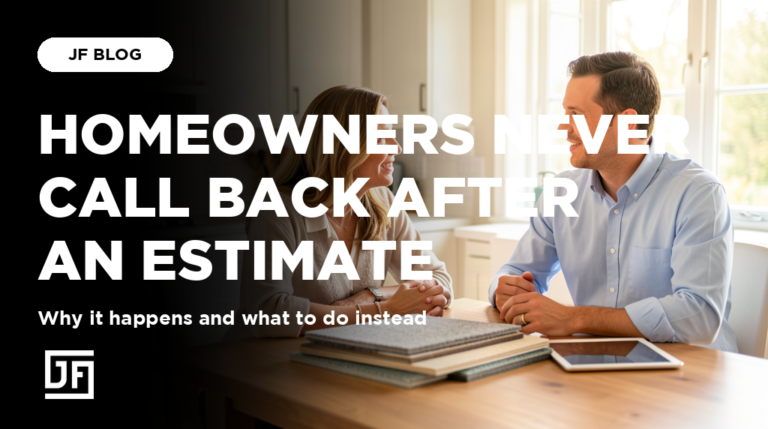
Here is what actually happens at the kitchen table. The homeowner has three bids that look basically the same on paper: same scope, same materials list, same ending. When bids look identical, price is the only thing left to compare. Comparison done wrong creates hesitation. Hesitation becomes negotiation. And negotiation is where you either drop your price or lose the job.
The homeowner is not lazy and not cheap. In a market this noisy, they are overwhelmed. They have been shopping for months, they are terrified of picking wrong, and when a buyer is uncertain they do not want more information. They want a leader. There is only room for one professional in that kitchen. Either they are the professional bid-collector, or you are the professional who helps them decide.
How do you stop being one of three bids?
Take control of the conversation before the numbers come out. You do not overcome objections. You prevent them. Price objections are created before the price is ever shown, which means the sale is won or lost in the conversation, never on the paper.
Most contractors do the same thing: measure, talk for an hour, write the number, hand it over, and leave. Now that homeowner is sitting alone with the biggest decision of their year, three other bids, and zero guidance. They freeze, and the silence after you leave is where most jobs die. A good mechanic does not tear into your engine the second you pull in. He runs the diagnostic first, because otherwise he fixes the wrong thing. Same with a remodel. Before you quote anything, run a real diagnostic on three things. One, what they want: when this is done, what has to be different about how you live in this space? Two, what they have now: what is working that you want to keep, and what drives you crazy? Three, what they have already seen: who else have you talked to, and what did those bids leave out?
Those questions do something the other two bidders never do. They move the decision off the paper and onto certainty, and certainty is the only thing a nervous homeowner actually buys. When you are the one who named the real problem, the other bids start reading like gambles.
What do you say when homeowners say they are getting other bids?
Do not fight it and do not fold. Say this: smart, you should compare. Let me make it easy. Most people comparing three bids are comparing on price, because on paper the bids look the same. So here is what I would ask each of them. Ask who is actually on site each day. What happens when they find something behind the wall they did not expect? And what is their process when something goes wrong two years from now?
You just walked into the conversation they were about to have without you. You handed them the three questions only you answer well, and you did it without saying a negative word about anyone. That is not pressure. That is leadership, and homeowners can feel the difference immediately. The bids that fold under those questions were going to produce a nightmare project anyway.
Why does discounting lose the next job too?
Because every discount teaches the buyer to wait. The next homeowner finds out what the last one paid, and now your discount is the starting point of the next negotiation. Discounting trains customers to disrespect your price, and it trains the market to wait for your next sale. You are not too expensive. You are losing control, and the discount is how you surrender it.
There is a flip side you can use. When a competitor drops their price to win a job, the homeowner quietly starts wondering what they are cutting and why they are that desperate. A discount is engineered uncertainty. Let the cheap bid work against itself by holding your standard instead of matching it. The homeowner who chooses the cheap bid was never going to be your customer. The one who wants the job done right is looking for exactly the confidence you are protecting.
What does winning without discounting look like?
Real numbers, real companies, names left off out of respect. Dallas, an owner of a roofing company, watched one of his reps sell two of his last three leads after learning to run the conversation this way, and the same rep set his own close-rate goal for the next month, higher than his company average. A roofer I know made one change: his goal in every home stopped being sign the deal and became give this homeowner the best sales experience of their life. By mid-season he was twenty-six thousand dollars ahead of the prior year. Richard, who owns a window and door company, saw his two highest revenue months in the company’s fourteen-year history land back to back, roughly doubling his business in sixty days, and one rep who could barely hold a customer conversation at the start closed over two hundred thousand dollars in a single month.
The market made all of that harder, not easier. In the Q3 2026 USRenovation Index survey, 45 percent of home-improvement professionals reported fewer leads, homeowners are collecting three or more quotes, and many are trading down to cheaper bids. The National Roofing Contractors Association’s Q3 2026 survey found 27 percent of roofers with no backlog at all. That is price-shopping weather, which means the conversation is the only advantage left. The market will never do your selling for you, ever again. It hands you fewer, more careful buyers, and it rewards the contractor who gives them certainty instead of a coupon.
Is this the part of the job that is only human?
Yes, and it is the part I am building an entire category around, called Only Human. AI can write your estimate in thirty seconds and answer the phone all night. It cannot sit across a kitchen table from a nervous homeowner and transfer certainty, safety, and trust. That transfer is human work, and in high-ticket home improvement it is the whole sale. A tool can carry the busywork. Only a leader can give a family the courage to decide.
That is also why this is an identity shift and not a technique. You are no longer a contractor who happens to have to sell. You are a leader who engineers certainty, and your company is a certainty business that happens to install roofs and kitchens. I wrote about the selling leadership style that builds this kind of team here, because the same shift that wins the kitchen table wins the team meeting.
Frequently asked questions
- How do I stop losing bids to cheaper contractors without cutting my price? Take control of the conversation before the numbers appear. Run the diagnostic questions, name the real problem, and hand the homeowner the questions only you answer well. Losing bids to cheaper contractors is a frame problem, not a price problem.
- Should I ever lower my price to win a job? If the job only closes at a discount, the certainty was never built. A price cut reads as engineered uncertainty and teaches the buyer to wait for the next one. Hold the standard, and let the cheap bid expose itself.
- How long does it take to change my close rate? Twenty-one days to change a habit, ninety days to change a behavior, a year to change a company. Owners who coach the conversation weekly see reps move inside the first month.
- Does this work in a slow market? It matters more in a slow market. When nearly half of home-improvement pros report fewer leads, every lead you get deserves a real conversation, not a dropped-off estimate.
You are not losing bids to cheaper contractors because your work costs too much. You are losing because the homeowner was left alone with a decision you never helped them make. Take the table, run the diagnostic, and give them the courage to decide. That is a different business, and it starts with one conversation. If you want that for your company, book your strategy call.
Want to hear me teach this directly? Watch the video: Avoid this mistake when a buyer tells you “you’re too expensive.”

Related reading:
- The selling leadership style that builds warriors
- What AI sales coaching can and cannot replace
- How to handle rejection in sales without losing confidence
About Jason Forrest
Jason Forrest is a sales leadership trainer and the CEO and founder of Forrest Performance Group, a global sales and leadership training company. A nine-time author and Global Gurus’ #1 sales trainer in his category for 2025, Jason created Leadership Style Selling, Warrior Selling, and the Performance Formula, Performance = Knowledge − Leashes. He coaches owners, CEOs, and sales leaders one on one, and his work is deployed inside some of the world’s highest-performing sales organizations.