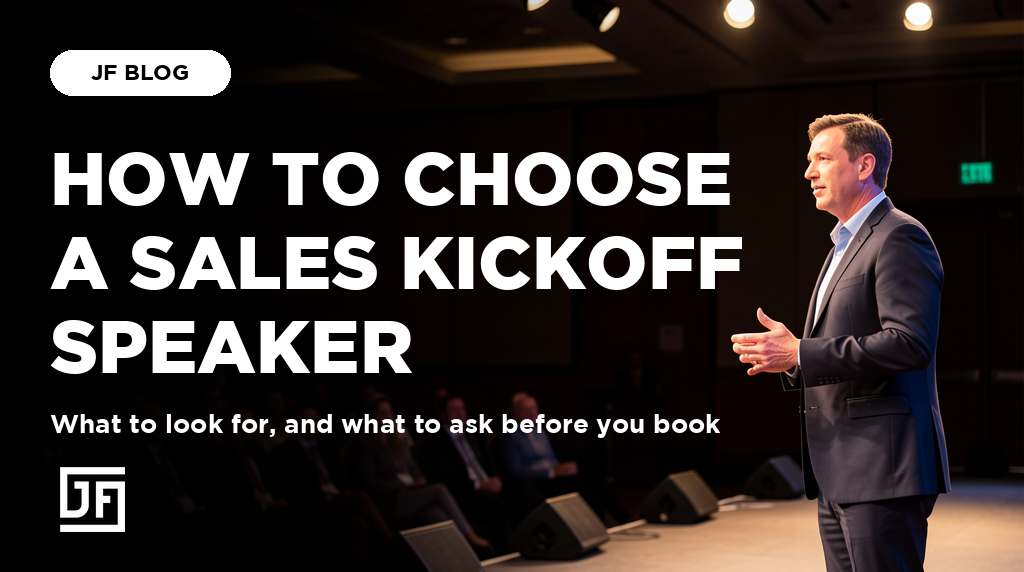
The best sales kickoff speaker for your team is the one who leaves the room with new language and new behaviors your people are still using in March. Notice what I did not say. Not the funniest one, not the most famous one, not the one with the slickest demo reel. Your kickoff is the one meeting all year where every seller you pay sits in one room, awake, staring at the year ahead. Whoever holds that stage is telling your team what selling is supposed to look like for the next twelve months. So before you sign anybody, including me, here is what the job actually is, what separates a sales kickoff speaker who rewires a team from one who merely entertains, and the questions I would ask every candidate.
What does a sales kickoff speaker actually do?
A sales kickoff speaker has one job: change what your team does the Monday after the event. Not inform them. Not energize them. Change them. Training done right is a window and a mirror. It shows people the standard, and it shows them where they stand against it. Your kickoff opens that window for the year, and the person on stage sets the standard your sellers will either rise to or shrug at.
Most keynotes fail that test in the first ten minutes. They run war stories, they run jokes, they run a highlight reel of other people’s success, and the room feels fantastic for exactly one evening. By the second week of February nobody remembers a sentence from it. An event changes nobody. Twenty-one days changes a habit, ninety days changes a behavior, and a year changes a culture. The right speaker knows that and builds the hour to start something, not to be something.
I will be as blunt with you as I am with the rooms I stand in. In 2025 Global Gurus ranked me the number one sales trainer in the world, and I am telling you that if all you get from any speaker is a good talk, you wasted your money. The talk is the door. Structure walks through it.
What should you look for in a sales kickoff speaker?
Four things, and you can screen for every one of them before the booking call ends.
1. They sell your reality, not a generic one. Ask what they know about your market, your buyer, and the objection your team hears most. A speaker who cannot name the wall your sellers hit every week will hand you inspiration that dies on contact with your world. The words change when the talk matches the street your team actually works.
2. They teach language, not just lessons. Inspiration evaporates. Language sticks. When your sellers walk out with the exact words for handling the price objection, the exact opening that earns a second meeting, that is something they can run the next morning. Skills live in sentences. A speaker who gives you concepts but no sentences has given you nothing portable.
3. They talk about the day after. Ask what happens the week following the keynote. Do they leave your leaders with anything to coach against? One talk is an event, and events change nobody, but a talk designed to hand your managers a follow-up structure changes the quarter. The speakers worth booking speak about your sales leaders as partners in the room, not as audience members.
4. They make your leaders part of the story. Your team will follow what your leaders believe, not what any visitor says. The right keynote works your leadership into the message, because your salespeople hear the standard from the stage but they adopt it from their coach. If a candidate never asks about your leaders, that tells you everything.
Why most kickoff talks are forgotten by February
Because a kickoff with no follow-through is motivation theater. I have sat through the crying-guy-on-stage seminar. Everyone feels something, everyone leaves taller, and nothing on the sales floor changes. Feeling is not the deliverable. Behavior is.
Here is the standard I hold my own dojo sessions to, and I would hold any kickoff speaker to the same one: the twenty-four hours after the session should be the best twenty-four hours of your seller’s week. Not because the room was electric, but because the next morning they had new sentences to run and a leader who asked them to run those sentences. That is a measurable standard. Applause is not.
The follow-up belongs to you as much as to the speaker. Book the talk as the start of a ninety-day push, not as the whole program. Plan the sales meetings for the weeks after, plan the one on ones, plan what your managers will coach against. Then a one-hour keynote becomes the first day of a behavior instead of a line item in the budget.
Should you book a motivational speaker or a sales kickoff speaker?
Know the difference, because it decides what you get for the fee. A motivational speaker lifts the room’s emotion. A sales kickoff speaker installs behaviors that lift the room’s numbers. Energy is a vehicle, not a destination, and there is nothing wrong with a vehicle, but you need to know where it is driving. Warrior mindset matters at a kickoff, more than any other meeting of the year, because your team sets its identity in that room. I teach that a warrior is a seller with zero excuses, all in on the process, running the plays when nobody is watching. That identity is exactly what a January stage should be installing.
Want to hear how I teach it? Watch the video: The Sales Warrior Mindset That Sets You Up for Success.
One more thing, because I would be lying if I pretended your kickoff happens in a world without AI. Your sellers will soon have an answer for every product question a machine can hold. What the machine cannot carry is the identity your kickoff is for, the courage to hold a price, the certainty a buyer can feel across a table. A kickoff is one of the most only-human moments your company runs all year, and it is why I build the category I call Only Human: give the busywork to the machines, and spend the year making people harder to replace.
What questions should you ask before you book one?
Bring these to every booking call, and you will hear the difference between performers and practitioners inside five minutes.
- What do you know about our market and the objection our team hears most?
- What sentences will my sellers walk out saying that they were not saying this morning?
- What do my sales leaders do with your material the week after?
- How do we measure whether this worked, thirty days out?
- Where does your talk end and our coaching begin?
The last two are the ones that matter. Any speaker who cannot answer the measurement question is selling you a feeling with a receipt for a fee. Any speaker who cannot answer the coaching question is selling you an event, and one event a year is not structure.
How do you measure whether your kickoff worked?
Measure behaviors, not applause. Pick two or three observable behaviors the talk was supposed to install, the language your sellers should be using with buyers, and watch for them in the thirty days after. Ride along and listen for the new sentences. If they showed up, the kickoff worked, and the coaching system deserves the credit alongside the speaker. If they never showed up, you learned something cheap: the talk matched nothing your managers were asking for, which is a booking mistake you never make twice.
And ask your sellers one question thirty days out: what is one thing you still do differently since the kickoff? If the answers come back blank, no one was rewired, whatever the survey scores said. If the answers come back in specific language, you chose well, and your people are one skill further along than they were in January.
Frequently asked questions
1. How far in advance should you book a sales kickoff speaker? The strong ones are locked months ahead, and November is exactly when the best dates for January and February go. Book as early as you can, because the calendar does the filtering a demo reel cannot.
2. What is the difference between a keynote and a workshop at a kickoff? A keynote sets the identity and the standard for the whole room. A workshop runs the new language live, with reps on their feet. The strongest kickoffs sequence both, because identity opens the day and practice seals it.
3. Can one talk really change behavior? One talk opens the door. Structure walks through it. Twenty-one days changes a habit and ninety days changes a behavior, so the talk is the start of a system, never the whole system.
4. Should the speaker customize to our industry? Yes, and insist on it. A talk that does not name your market, your buyer, and your objections is a rented speech, and your sellers can smell the difference from the back row.
Your kickoff deserves a speaker who treats the hour as day one of a behavior, because your team only gets one shot at setting this year’s identity. If you want that kind of opening for your team, book your strategy call.

Related reading:
- What makes a great sales keynote speaker?
- How to choose the right sales speaker for your team
- Why a sales keynote speaker should rewire, not inspire
- Keynotes for sales teams
- Sales kickoff speaker for home builders
About Jason Forrest
Jason Forrest is a sales leadership trainer and the CEO and founder of Forrest Performance Group, a global sales and leadership training company. A nine-time author and Global Gurus’ #1 sales trainer in his category for 2025, Jason created Leadership Style Selling, Warrior Selling, and the Performance Formula, Performance = Knowledge − Leashes. He coaches owners, CEOs, and sales leaders one on one, and his work is deployed inside some of the world’s highest-performing sales organizations.