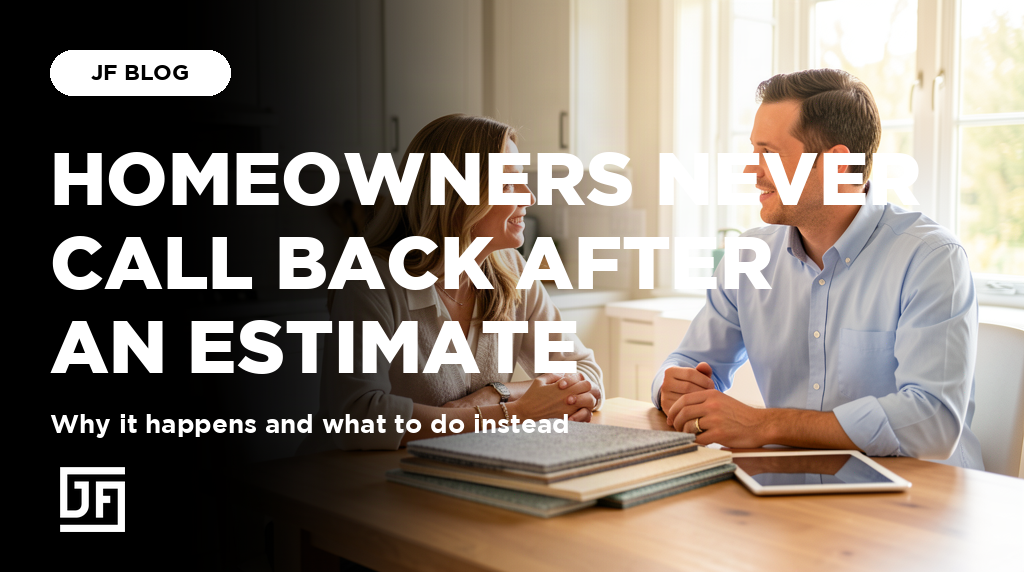
Homeowners never call back after an estimate because the appointment ended without a decision, and an unmade decision does not get made in silence. When your rep leaves a kitchen table with “I’ll get back to you,” the homeowner is not holding a lead. They are holding a maybe, and a maybe is the most expensive thing in your pipeline. Nothing about your craftsmanship or your price is being tested in those two silent weeks. What is being tested is who leads the decision, and right now that is nobody. The good news is that ending appointments with a decision is a skill, which means your team is one skill away from a pipeline that resolves. In this article I will show you why homeowners go quiet, what “I need to think about it” actually means, and the standard that ends every appointment with a yes, a no, or a next step on the calendar.
Why do homeowners never call back after an estimate?
Because the estimate was the only thing your rep left behind. A number without a decision is a homework assignment for the homeowner, and nobody enjoys homework about a thirty-thousand-dollar project. They sit down alone, open your estimate next to two others, and every bid looks the same on paper. Same scope, same materials list, same ending. When three estimates look identical, the only thing left to compare is price, and the cheapest number wins a contest you never meant to enter.
Then the silence starts. The homeowner is not ignoring you because they are rude or busy. They are stuck, and stuck people do not return phone calls. They are afraid of picking wrong, afraid of the salesperson who made them feel pressured, and afraid of the contractor who made them feel nothing at all. A buyer who is uncertain does not want more information. They want a leader, and your rep went home.
Here is the line I want you to sit with: an open-ended ending is an unmade decision, and unmade decisions rot. No follow-up sequence resurrects a decision that was never made. More voicemails are not the answer. The appointment was.
What is a homeowner really saying with “I need to think about it”?
They are not thinking about it. Nobody spends two weeks thinking about a bathroom. They are telling you the certainty was never built, and hesitation is a symptom, not an objection. The moment your rep treats “I need to think about it” as a request for time, they hand the decision to silence. The moment they treat it as unfinished business, they can finish it.
Behind almost every stalled in-home sale sit the same three truths. The homeowner cannot picture the decision being safe. Someone who needs to sign is not in the room. Or a past project went badly and the memory is doing the talking. Notice what is missing from that list: your price. Homeowners never call back after an estimate because of fear far more often than because of money, and fear does not answer the phone.
This is where most training fails your team. It teaches reps to overcome objections instead of preventing them, so the rep waits for the stall and then starts chasing. Warriors do it the other way around. They acknowledge the hesitation out loud, they uncover what is actually behind it, and they resolve it at the table. Acknowledge, uncover, resolve. That is the framework, and it runs on the identity of the person saying it, not the words alone.
What should every appointment end with instead?
A yes, a no, or a scheduled next appointment. Scheduled time, scheduled date, scheduled location. No more open-ended “I’ll get back to you,” because open-ended endings are how homeowners never call back after an estimate in the first place. The standard is not aggressive. A no is a perfectly good outcome, because a no today frees your rep to go sell someone who wants the work. A maybe that rots for a month is the only unacceptable ending, because it steals your calendar twice.
An owner I will call Richard, who runs a windows and door company, put it this way after his team adopted the standard: ending an appointment with a yes, a no, or another appointment streamlined everything, because follow-up stopped being open-ended guessing and became a scheduled conversation. In the sixty days after his team started running appointments this way, he had his two highest revenue months in the company’s history, and a rep who could barely hold a customer conversation at the start closed over two hundred thousand dollars in a single month.
Do not confuse resolving with pressure. Pressure pushes a homeowner to sign before they are certain, and homeowners feel it instantly. Resolve is the opposite move. It is leading a stuck person to a decision they are relieved to make, giving them the courage that they cannot fail. One forces a transaction. The other starts a transformation, and only one of them gets referrals.
How do you coach your team to resolve instead of chase?
Start with the leash, not the script. Most reps leave appointments open-ended because they believe the decision belongs to the homeowner and their job ends at the estimate. That belief is a leash, and as long as your team wears it, they will keep choosing comfortable silence over leadership. Coach the belief first: a salesperson is a professional who helps families decide, and a professional never leaves a decision unmade when it can be made today.
Then change the question you ask in your one on ones. A manager asks “did you follow up with that lead?” and gets a list of voicemails. A coach asks “where did the conversation leave the homeowner?” and gets the truth. If your rep answers “she is thinking about it,” you have found the exact moment to rehearse. Run the acknowledge, uncover, resolve framework right there on the stalled deal, and send them back to finish the conversation instead of chasing it.
Expect this to take coaching, not a memo. Twenty-one days to change a habit, ninety days to change a behavior, and your reps will relapse into follow-up mode under pressure. The teams that get there are the ones whose leader runs the standard every week until the resolve ending is who they are, not what they were told.
Why is waiting the most expensive habit in home improvement?
Because waiting is not free for anyone. The homeowner who waits two months for certainty pays in rising material costs and another season without the kitchen they wanted. Your company pays in a pipeline full of maybes that look like revenue on the board and produce nothing, while your reps spend their best hours chasing people who were never led to a decision. I have watched owners pour money into lead generation while their real leak was appointments that ended in “I’ll get back to you.” New leads into a company that cannot resolve conversations is just a faster way to fill the same silent graveyard.
Richard told me waiting was the thing that nearly took his business, that putting off the decision to train his team this way could have cost him the company and his retirement. That is the honest price of open-ended endings. They feel polite. They cost everything. The same math runs in every contracting market, and the market will never do your selling for you, ever again. It hands your team fewer, more careful homeowners, and it rewards the company that gives them certainty on the first visit instead of an estimate and a hope.
Is this the part of the job that is only human?
Yes, and it is the part I am building an entire category around, called Only Human. AI can send the follow-up sequence, draft the estimate in thirty seconds, and text every stalled lead forever. It cannot sit across a kitchen table from a nervous homeowner and transfer certainty, safety, and trust. That transfer is human work, and in high-ticket home improvement it is the whole sale. A tool can carry the busywork. Only a leader can give a family the courage to decide.
That is also why the fix is never just a script. It is an identity shift. Your team stops being estimators who hope people call back and becomes leaders who engineer certainty, one appointment at a time. I wrote about the selling leadership style that builds this kind of team here, because the same standard that wins the kitchen table wins your team meeting too.
Frequently asked questions
- Why do homeowners never call back after an estimate? Because the appointment ended open-ended and the homeowner was left alone with an unmade decision. Silence is not rejection of your price. It is what an unled buyer does next.
- Should my team follow up more often? Follow-up volume cannot fix an appointment that never resolved. Replace the open-ended ending with the standard, a yes, a no, or a scheduled next appointment, and the follow-up question mostly disappears.
- How do I get my reps to stop ending appointments with “I’ll get back to you”? Coach the belief first, then rehearse the acknowledge, uncover, resolve framework on real stalled deals in your one on ones. A standard becomes behavior after about ninety days of weekly coaching.
- Does resolving on the first visit feel pushy to homeowners? Not when it is done as leadership instead of pressure. Resolving means uncovering the real hesitation and leading the homeowner to a decision they feel good about. Homeowners reward it with trust and referrals.
You are not losing jobs to silence because your work is not worth it. You are losing them because your team leaves the decision in the homeowner’s hands and hopes. Take the table, uncover the real hesitation, and give the family the courage to decide. When your company wants its whole team selling that way, book your strategy call.
Want to hear me teach this directly? Watch the video: What to Say When Buyers Say “I Need to Think About It” (The In-Home Sales Version)

Related reading:
- The selling leadership style that builds warriors
- Why isn’t my sales team closing
- How to handle rejection in sales without losing confidence
About Jason Forrest
Jason Forrest is a sales leadership trainer and the CEO and founder of Forrest Performance Group, a global sales and leadership training company. A nine-time author and Global Gurus’ #1 sales trainer in his category for 2025, Jason created Leadership Style Selling, Warrior Selling, and the Performance Formula, Performance = Knowledge − Leashes. He coaches owners, CEOs, and sales leaders one on one, and his work is deployed inside some of the world’s highest-performing sales organizations.