Quick test: if your top two reps took the same month off, what would happen to your revenue?
If the honest answer is “it would crater,” then you don’t have a sales process — you have heroes. And a business built on heroes isn’t really a business; instead, it’s a bet you re-place every morning.
I wrote Sales Freedom because I kept meeting owners trapped by exactly this — a book that grew out of the work I still do today at Forrest Performance Group. Specifically, companies doing $10M, $20M, $50M where the sales “process” lived entirely in the heads of two or three naturals. As a result, the owner couldn’t forecast, couldn’t scale, couldn’t even take a real vacation. The revenue was real, but the freedom wasn’t.
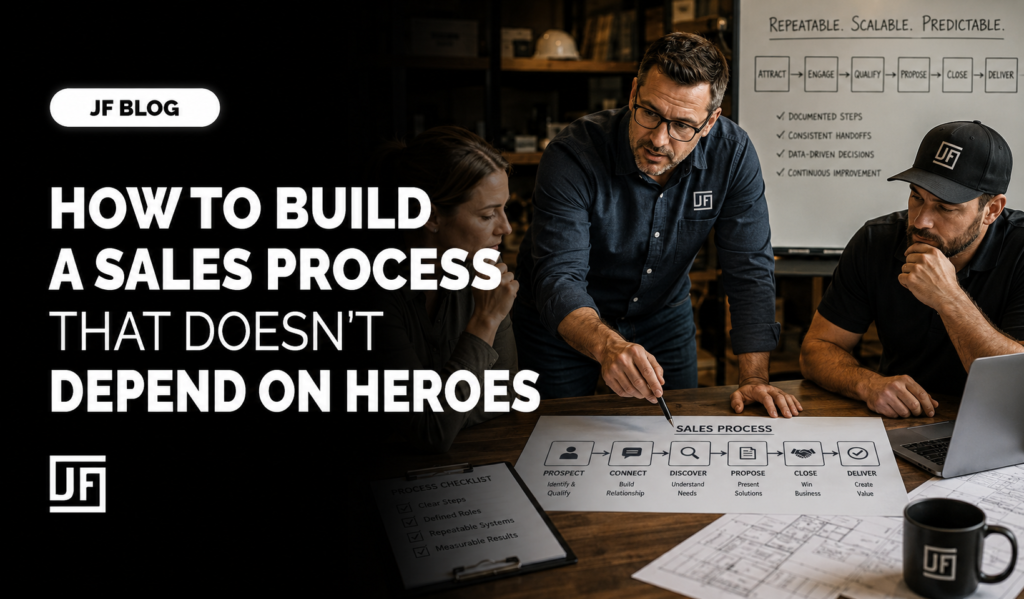
The way out, instead, is an operating system — a documented, trainable, coachable way of selling that turns your team’s best moves into everyone’s standard moves. So here’s how to build a sales process that doesn’t depend on heroes, step by step.
THE MARKET RIGHT NOW: Contractors are making this same mistake industry-wide, and one owner named it perfectly: “Your sales team does not have a lead problem. They probably have a sales process problem.”⁶ It matters even more with an exit in mind — private equity buyers are rolling up trades and home services companies aggressively, but they’re not paying premium multiples for a book of leads. They’re paying for a business that runs on a system instead of a founder.⁷

WHY “SALES PROCESS” GETS A BAD NAME
Most sales processes fail because they’re built for the CRM, not for the buyer: seven stages with names like “Discovery” and “Negotiation,” designed so management can run reports. As a result, reps treat them as data-entry chores, because that’s what they are.
A real sales process, instead, answers a different question: what does the buyer need to experience at each step to move forward with confidence?
Win the experience, and you win the sale. Your process, in other words, is the recipe for that experience — repeated by every rep, on every deal, at a professional standard. Get that right, and the reporting takes care of itself.
HOW TO BUILD A SALES PROCESS: STEP 1, STEAL FROM YOUR OWN WINNERS
Don’t buy a generic methodology and bolt it on. Instead, your best process already exists — in fragments, inside your top performers.
So pull your last 25 wins and your last 25 losses, then watch the tape: call recordings, email threads, proposals. You’re hunting, specifically, for the moves your winners make that your average reps don’t. For instance: what questions do they ask in the first meeting? When do they bring up money? How do they handle “we need to think about it”?
Write those moves down — that’s your raw material, proof rather than theory, which means your reps will actually believe it.
STEP 2: MAP THE BUYER’S YESES, THEN YOUR STAGES
Before you name a single pipeline stage, first list the sequence of commitments a buyer makes on the way to a deal. Something like: yes, this problem is costing me money → yes, I’ll bring my business partner into this → yes, this approach would work here → yes, this timeline and this investment.
Then build one stage per commitment. Each stage, specifically, gets three things:
- The objective — the buyer commitment that ends this stage
- The plays — the questions, demonstrations, and conversations your winners use to earn it
- The exit evidence — the verifiable thing the buyer did, so a deal can’t advance on vibes
This, ultimately, is the difference between a process and a pipeline report. A pipeline report tracks what your rep did; a process, on the other hand, defines what the buyer confirmed. It’s the same discipline that makes your forecast believable instead of hopeful.
STEP 3: SCRIPT THE MOMENTS THAT MATTER
“Script” makes some leaders flinch, because they picture robots reading teleprompters. That’s the wrong picture, though. Great scripts, instead, work like a pilot’s checklist: they free the professional to focus on the human in front of them, because the fundamentals are automatic.
You don’t need to script everything — just the seven or eight moments where deals are won or lost:
- The first 90 seconds of a first meeting
- The question that surfaces the real cost of the problem
- The price conversation
- The moment the buyer says “we need to think about it”
- The ask that earns the next commitment
Specifically, word-for-word language, drawn from your winners, drilled until it’s natural. Because when a rep knows exactly what to say in the hardest moments, confidence stops depending on personality. That’s how average reps start performing above their old ceiling — the same shift I coach new-home sales teams through in the 5-Day New Home Sales Challenge.
STEP 4: TRAIN IT LIKE A CRAFT, NOT A ROLLOUT
Here’s where most process initiatives die: the company builds the playbook, holds a two-day launch, and declares victory. Then, ninety days later, everyone’s back to their old habits and the binder is a coaster.
Instead, a process becomes an operating system only through reps — repetition, role-play, drilling. In short, salespeople learn the way athletes learn:
- Drill weekly: Ten minutes of role-play in every team meeting — one scripted moment, run live, in front of peers.
- Coach to the process: Managers review real calls against the playbook and coach the gap, one constraint at a time.
- Certify it: A rep isn’t “trained” just because they attended. Rather, they’re trained when they can run each play live under pressure — so test it.
Discipline, craft, pride — that’s the warrior standard, and your team will rise to it if you hold it.
STEP 5: INSPECT THE SYSTEM, NOT JUST THE NUMBER
Once the process is live, your leadership meetings change. Instead of only asking “will we hit the number,” you can now ask why — with precision:
- Which stage do deals stall in most? That’s a training gap, not a market problem.
- Which rep converts stage two at half the team’s rate? That’s a coaching assignment with a name on it.
- Where do buyers consistently go dark? That’s a broken play — so rewrite the play, not the rep.
This, ultimately, is what forecast credibility is actually made of. When your process defines evidence at every stage, your commit becomes a calculation instead of a wish.
THE FREEDOM ON THE OTHER SIDE
Build the operating system, and three things happen: first, your revenue stops depending on individual heroics, because new hires ramp faster when there’s something real to learn. Second, your forecast holds, because deals advance on buyer evidence. And third, you get your time back, because the business finally runs on a system instead of on you. It’s also your best defense against the turnover math quietly draining your margin — reps stay where the craft is real.
That’s the whole point, ultimately — not process for its own sake, but freedom. For you, and for every rep who’s been winging it and calling it a career.
So you don’t need better heroes — you need a better system, and it’s yours to build.
Ready to build it? JOIN THE MINDSET OF A SALES LEADER MASTERCLASS →
Want more like this? Browse the full blog →